
Assessing Moisture in Power Transformers
A Standards-Aligned, Multi-Method Approach
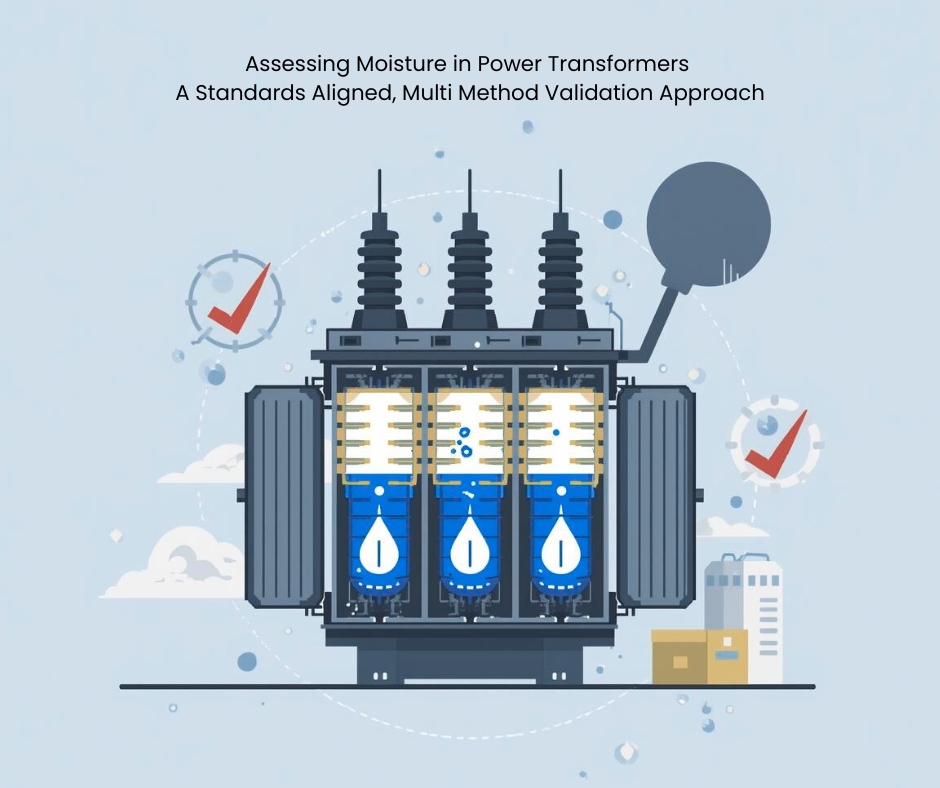
Moisture in transformer insulation critically impacts dielectric strength, accelerates cellulose ageing, and reduces asset reliability. As no single diagnostic method can accurately quantify moisture in solid insulation, PTss follows a standards aligned, multi-method evaluation approach to validate Online Transformer Dryout System performance through field case studies.
Drying effectiveness is assessed using electrical, chemical, and equilibrium based diagnostics, benchmarked against international standards and global best practices:
🔹 DOBLE methodologies for moisture assessment in paper insulation
🔹 Oommen equilibrium curves (IEEE / CIGRE) for oil–paper moisture distribution
🔹 S.D. Myers nomograms for interpreting dielectric behaviour of cellulose
🔹 Power Factor (tan δ) of pressboard as per IEC 60247 / ASTM D924 / IEEE C57.12.90
🔹 Oil moisture analysis (Karl Fischer & %RS) per IEC 60814 / ASTM D1533 / IS 6103
🔹 Dielectric response concepts referenced in IEC 60076-19 and IEEE C57.152
🔹 CIGRE A2 Working Group Technical Brochures for global benchmarking
By correlating these methods, PTss quantifies moisture reduction in solid insulation, validates drying performance without shutdown, and demonstrates sustained improvement in insulation health for power and generator transformers.
📌 Effective transformer drying is not just moisture removal it is verifiable improvement supported by international standards and field evidence.
While frequency-domain diagnostics are the latest tools, traditional tests (IR/PI, 1:5 ratio, step voltage) continue to provide valuable moisture and contamination indicators where advanced instruments are unavailable.
PTss applies both conventional and advanced assessment methods, with estimated %M/Dwi displayed on our Online Transformer Dryout Systems. Consistent reduction in oil moisture and improved tan δ values validate effective drying.