
Particle Contamination in Transformers: An Invisible Risk to Insulation Life
Particle contamination remains one of the most underestimated yet critical contributors to transformer insulation degradation.
Extensive studies, including CIGRE WG 12.17 – “Particles in Oil”, have linked a significant number of major transformer failures, particularly in the 400-800 kV class, directly to particle contamination. These particles, often invisible to the naked eye, play a decisive role in reducing dielectric strength and accelerating insulation ageing.
Key particle classifications and origins include:
* Manufacturing and assembly residues (cellulose fibres, sand, metallic particles)
* Field contamination during installation and maintenance
* Passive ageing by products (oil sludge, paint flakes, polymer films)
* Active operating contaminants (carbon from OLTCs, metal wear, arc debris)
Among these, conductive particles such as metals, carbon, and wet fibres pose the highest dielectric risk. Under strong electromagnetic fields, especially in power transformers and shunt reactors – particles migrate and deposit on barriers, winding surfaces, and bushing porcelain, significantly lowering insulation safety margins.lation ageing.
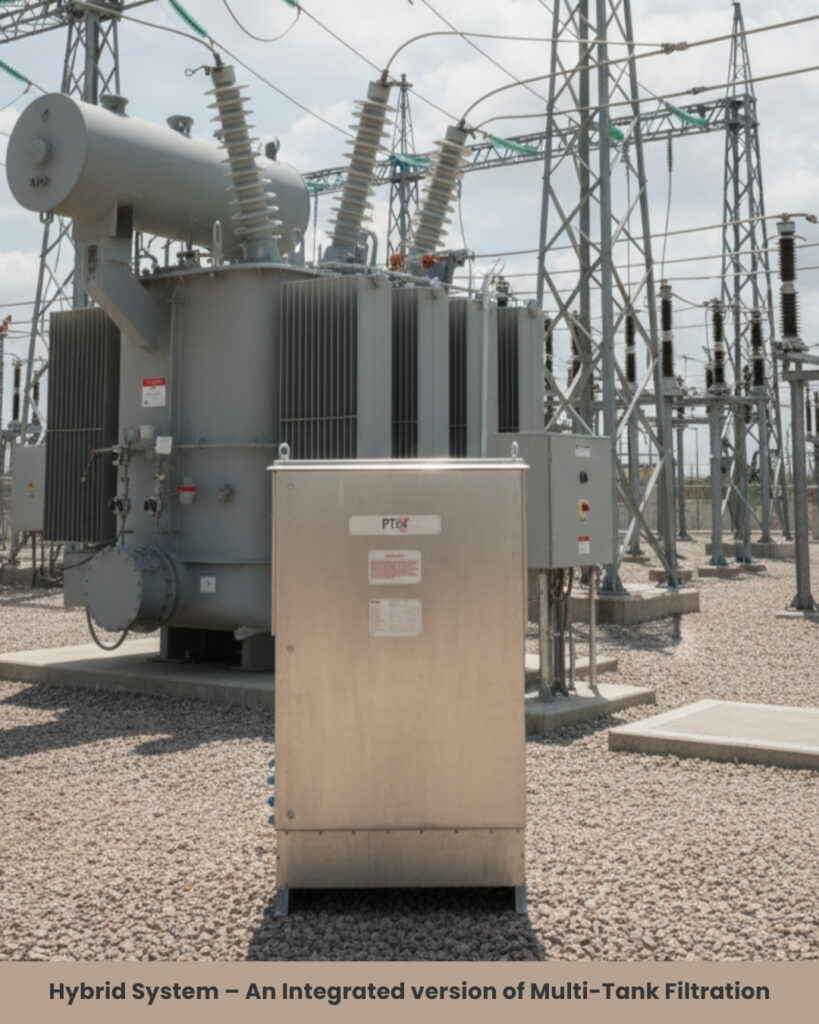
PTSS Online Transformer Dry-Out Systems and Online OLTC Filter Systems,available in hybrid configurations as well, are designed to address this challenge by enabling:
• Continuous removal of moisture and solid particles during operation
• Reduction of conductive and ageing-related contaminants without outages
• Preservation of dielectric integrity under real operating conditions