
Moisture in Transformer Insulation: Why Timely Action Matters
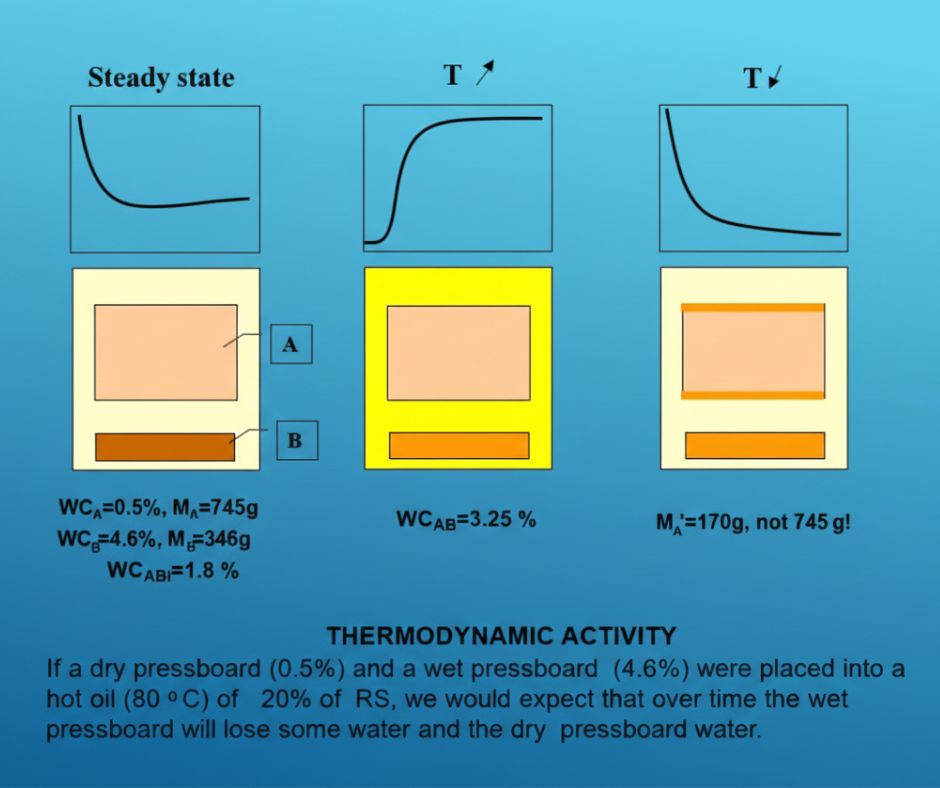
The attached IEEE illustration highlights a fundamental insulation principle (Water-in-activity concept Awp, RS, WCP(%), WCO(ppm)):
When dry (~0.5%) and wet (~4.6%) pressboard are exposed to hot oil (~80 °C), moisture migrates but never equalizes.
Moisture behavior is governed by thermodynamic activity and equilibrium, not simple diffusion.
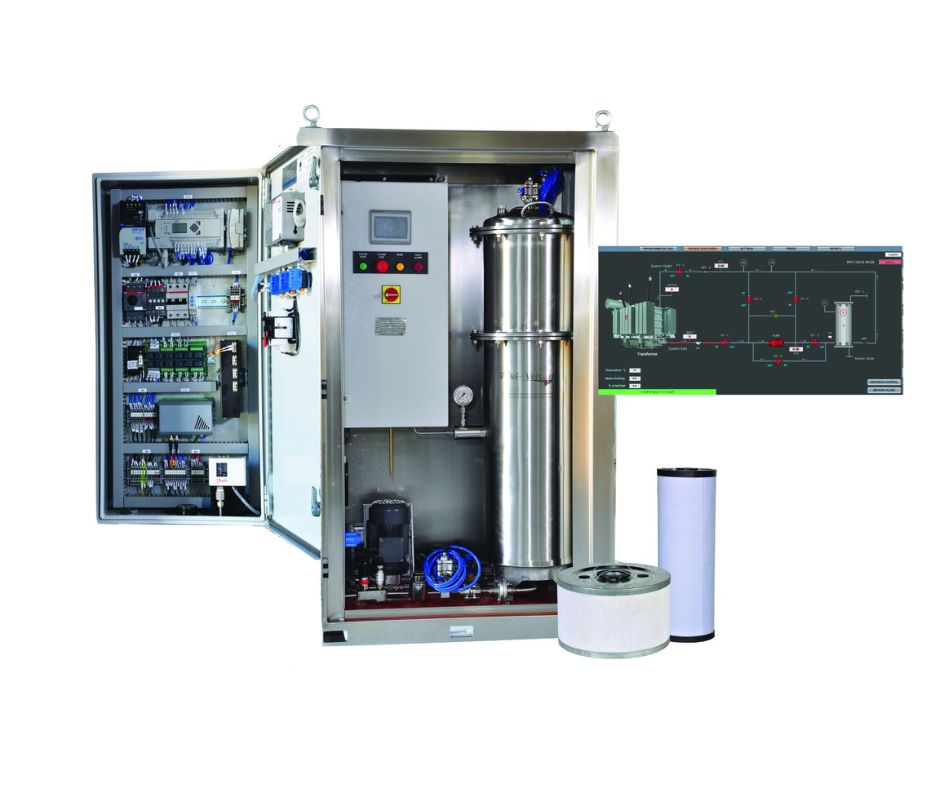
This principle is the scientific basis of PTss Online Transformer Drying Systems enabling controlled, online moisture removal without external oil heating, while preserving original mineral oil characteristics.
What builds trust is evidence, not assumptions
PTss case studies from our valued customers demonstrate moisture assessment, removal, and validation using multiple globally accepted methods:
-
Karl Fischer titration
-
Dielectric Loss Factor (tan δ)
-
Polarization & Depolarization Currents (PDC)
-
Dielectric Frequency Spectroscopy (FDS)
-
Water Heat Run Test
-
Oil–paper equilibrium charts
-
Insulation Resistance / Dielectric Absorption / Polarization Index
📌 Key takeaway
Moisture is not just a condition—it is a time-dependent risk. Managing it early, scientifically, and online is key to ensuring sustained transformer reliability, insulation integrity, and long-term asset life extension.
Delayed action allows moisture to trigger
Accelerated paper ageing
Vapour bubble evolution
Corrosion of core and tank
Reduction of PD inception voltage
Progressive depletion of oil additives
Loss of insulation dielectric strength
Irreversible reduction in transformer life